

Initially, the motivation was likely to attract voter groups such as crypto holders, tech-oriented individuals, and libertarians—partly as a sharp contrast to the policies of the Biden years, and partly as a form of rebellious culture war that suits Trump well. What likely started as pure electioneering has evolved into a unified American strategy to make the U.S. the global hub for the blockchain economy and to connect the dollar directly to the internet via "stablecoins."
Stablecoins vs. CBDC: What is the difference?
A CBDC is a crypto asset issued directly by a central bank, while a stablecoin is issued by a third party. Both aim to represent a currency unit like the krone, dollar, or euro.
Much of the criticism against CBDCs is that they could become the ultimate tool for a surveillance state, with granular control over all economic activity. In principle, interest rates, taxes, benefits, and trade access could be regulated at an individual level with a CBDC. Stablecoins, on the other hand, are in many ways a return to the privately issued money that was the norm 200–300 years ago. Back then, banks issued notes that were presumably backed by gold and could be exchanged for it. In the digital version, U.S. Treasury bonds are intended to serve as the collateral. The advantage of this is that it creates competition between issuers, and if a user doesn't like one issuer, they can switch to another.
From electioneering to strategy
During the first six months of the Trump administration, we have seen the shape of a well-thought-out geopolitical strategy with the crypto sphere as its building blocks. The duo of Scott Bessent (Treasury Secretary) and David Sacks (Crypto/AI Czar)—both highly successful investors and managers—have likely been instrumental in the planning.
In July 2025, Trump signed the first comprehensive U.S. stablecoin law (the GENIUS Act). Scott Bessent stated that stablecoins provide the dollar with an "internet-native payment rail," which is obviously correct, but the GENIUS Act also regulates the stablecoin market to ensure it is backed by U.S. Treasury bonds. Expanded use will therefore create increased demand for U.S. government debt, which will be absolutely necessary to sustain American public finances.
The following week, Bessent presented the goal of making the U.S. "the crypto capital of the world" and pointed to market structure legislation (the CLARITY Act) as the next building block.
Why all of this at once? Because of network effects. Money is a social network, and if one network is dominant, it is nearly impossible for other networks to compete. David Sacks, the Facebook investor, knows this!
The U.S. dollar is already the established standard for global payments. This has given rise to the so-called Eurodollar system. The Eurodollar system has nothing to do with the Euro and originated long before the European common currency was a real project. The name refers to dollars that are issued and circulate outside U.S. borders. In fact, there are many times more Eurodollars than actual dollars! USD-backed stablecoins will most likely gradually replace this system and serve as a way to maintain American financial dominance.
A timely question is how replacing one system with another leads to a net increase in demand for U.S. Treasury bonds. The answer is related to the multiplier effect in the banking system. While an extra dollar in bank lending (which creates the dollar into existence) creates a fraction—perhaps almost zero—demand for U.S. Treasury bonds, stablecoins will be represented by Treasury bonds at nearly a 1-to-1 ratio. In addition, the barrier to entry will be much lower, as anyone with a PC or smartphone can access stablecoins.
The combination of network effects, the best infrastructure, and the most service providers will cement the U.S. dollar as the standard option for international transactions in the digital age as well, because there are no real challengers. Thus, hypotheses suggesting that the dollar's time as the global reserve currency is over must be pushed further into the future. However, this does not mean that the value of the U.S. dollar will hold, only that it will hold relative to other fiat currencies (EUR, JPY, etc.).
How does this affect crypto investments?
The crypto surge is the result of two megatrends. The first is the continuous erosion of the purchasing power of fiat currency. The combination of existing debt, tax revenues, and demographics makes this a deterministic, albeit slow-moving, variable. The second is the expansion of network effects. The proliferation of stablecoins will be an accelerator for both trends. In other words, it will help lift the value of the entire crypto universe as such. Bitcoin, which plays the same role as gold in this universe, appears to be the asset that will indisputably rise in value. At the same time, many of the building blocks and service providers linked to stablecoins will see enormous gains. One need look no further than the IPO of stablecoin issuer Circle (NYSE: CIRCL) to understand the interest in this highly lucrative future industry.
At the same time, crypto is an industry where new innovation and disruption are routine. The market leader today is not necessarily the one that will be the market leader in five years. Regardless of who the winner is, the tailwind this industry has is undeniable. With potentially billions of users recruited through stablecoins, some of the value will be left in the broader ecosystem. Despite this, a survey conducted by Bank of America in August 2025 shows that most institutional investors have zero exposure to the crypto universe.
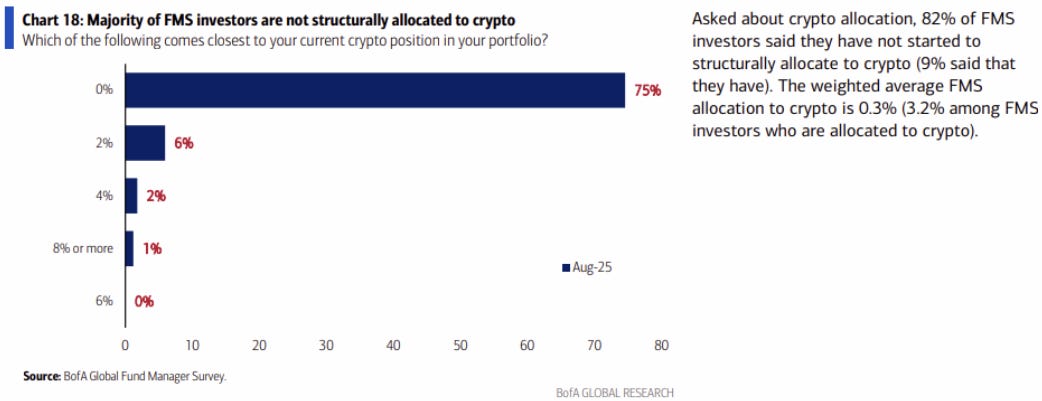
In other words: it is obvious that most decision-makers in the financial industry either still hold the attitude that "it's just nonsense" (let's call them the Warren Buffett generation; WBG), or they feel that the ship has already sailed. The boards and top management of most firms are still dominated by WBGs, which creates an extremely delayed reaction in the industry as a whole. But at some point, they will reluctantly retire or join the game for purely commercial reasons. This is what will lead to the truly massive unlocking of value in the crypto universe. It is still early in the journey.
The bubble everyone is talking about – and we cannot find in the data
It has become almost mandatory to call artificial intelligence (AI) a bubble. Comparisons to the dot-com crash and the fiber-optic build-out around the year 2000 are constant, and the investment figures are staggering: the largest cloud companies are expected to invest over $900 billion this year and nearly $1.5 trillion next year. When Avanto reviews valuations, capacity, financing, and interest rates, we do not find a bubble. On the contrary, the key companies are priced as if the AI offering is about to disappear, demand exceeds capacity, and the core is solidly financed. Risk exists, but it is narrower and far easier to identify than the bubble narrative suggests.
Who is shouting "bubble"? And why memory, of all things?
Micron has skyrocketed. So have SK Hynix and Samsung's memory division. And as if on cue, a host of people have appeared on X, in comment sections, and during coffee breaks who have found their new favorite word: bubble. Let's pause there for a moment.
Infinite supply
What happens when machines take over human labor? In 2022, what has subsequently been called “The Chat-GPT moment” occurred. In 2026, we will have what will eventually be called “The OpenClaw moment”.