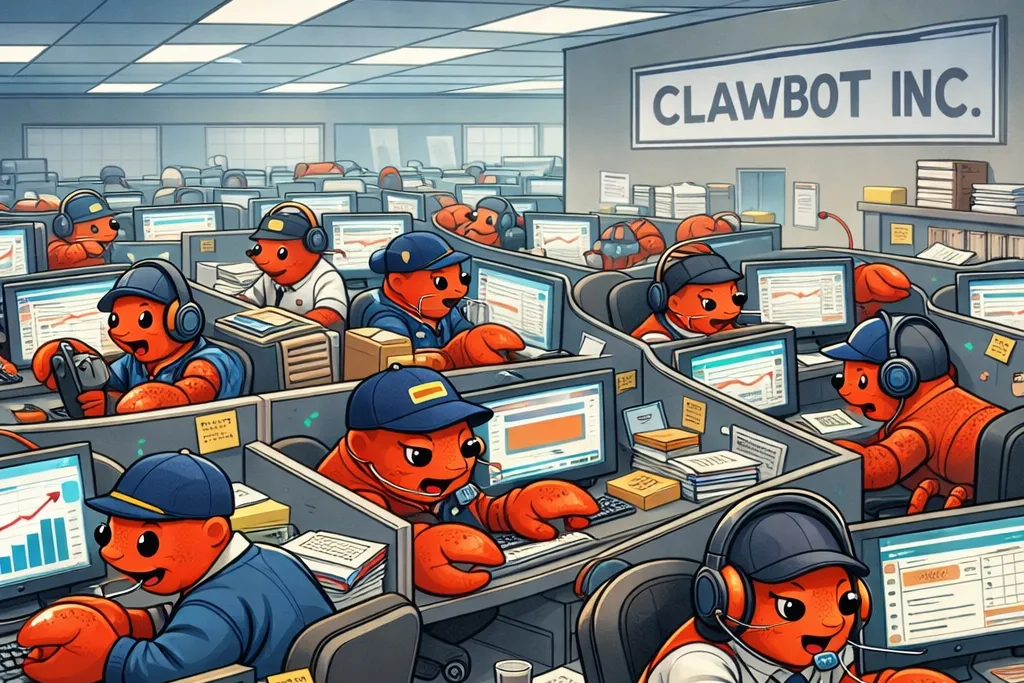

The world, at least the internet, is beginning to resemble a science-fiction series more and more than the reality most of us grew up in. Artificial intelligence has opened up ever new possibilities, and is on the verge of going from being a kind of distraction to making relevant inroads into the lives of most people. There are two camps that have cemented themselves, one is a kind of technology dystopia, perhaps not directly taken out of the “Terminator” franchise, but also not so far away. The other is an irrepressibly optimistic side, perhaps most often described as “Abundance,” iPeter Diamandis and Steven Kotler's 2012 book.
Both camps agree that KI is going to take over more and more human roles, the disagreement is whether it will be positive or not. In addition to these camps, there is a camp of deniers who are equally adamant that the whole thing is a momentary jippo. As usual, all these groupings have aspects that are correct, and that is what the financial market is now trying to price in.
From an investor perspective, focusing on the most extreme Terminator scenarios is of little relevance. Here comes the legend of the trader who bought everything he could during the height of the Cuban crisis in 1962: “If it goes wrong, we are all dead anyway!”
The camp that believes that artificial intelligence will never be able to become anything other than a “talking parrot”, we believe has now been disproved. But one point remains relevant: it is uncertain whether the creators of the model itself such as OpenAI, X.ai and Anthropic will be able to make enough money to defend the huge investments that need to be made. This still remains to be seen, but the competition from the Chinese providers is fierce, and in the familiar Chinese style, the quality is almost as good, but the price is far lower. The Chinese models are also “open Source”, said anyone who can/will can make changes to those, and one gets “crowd sourced” - development.
Even with the optimistic glasses, abundance is not positive for everyone. Especially not those who supply the various goods and services. Without some kind of scarcity, it is difficult to be able to take any material profit margin on delivery, and it will be useful as an investor to know where the abundance comes first, and where it may not arrive at all. This will come in phases and it is difficult to envisage that the market will be willing to reward earnings coming far into the future in the same way as before.
Here's a possible sequence:
Abstract Abundance
The vast majority of people who work via Keyboard and Mouse work with elements that have no physical manifestation. This is obviously the first stop on the road to abundance. Not surprisingly, it is the most IT savvy who have been hit first, as the management of IT companies are the best at assessing and understanding new technologies, and that the artificial intelligence has been developed precisely by IT experts. Even now, the machine can code better than the vast majority of professionals, which means that any beginner equipped with a subscription to a few hundred notes can create entire apps and new systems.
But other verticals are lining up for software and coding: financial services, consulting, legal services, etc all forms of “case management,” to borrow a widely used term from the public sector, can be done by far fewer people with far less effort, or without people involved.
This will make all services far more affordable, and the debate may be whether the job losses this causes for office workers will outweigh the gains from cheaper services.
The Agents
As artificial intelligence becomes more capable, something completely new will emerge: the agent economy. This is a very exciting thing: multi-billion new entrants in the economy making deals and trading with each other. Unlike humans, these actors do not want to sleep, eat or have free time. All the standardization of minimum trades has previously been on a human time scale, what with insurance contracts that are renewed every day, subscription services that are switched every hour, shipping routes that are auctioned off for every square meter, etc. When both the seller and the buyer are represented by an optimizing agent, all friction in trading collapses and the speed of circulation of the money supply also increases sharply. A machine does not need days of reflection time to buy a car, appliance or new PC. An agent probably also does not want brand loyalty, look in customary online stores, etc. Everything can then be traded directly from factory to consumer without many layers of intermediaries.
Such a new economy will require an unimaginable amount of tiny transactions that are completed in seconds. Such micropayments will be the obvious application of blockchain technology and in particular “Stablecoins”. Stablecoins also have tailwinds from US geopolitics.
While the price pressure on services will be deflationary, the increased rate of circulation of money will potentially be inflationary, at the same time it is virtually guaranteed that the amount of money will increase as the demographic glacier slides forward with its huge pension and care expenses, Another element in this context is how various AI agents should be taxed, where they should be fiscally domiciled, etc an obvious source of There is a greater need for deficit financing.
In addition to this, the fall in prices of more cognitive services will free up more capacity to spend money on services that cannot be replaced by a computer (tourism, human contact, etc.) and physical goods.
How the net effect on interest rates and inflation will be is thus somewhat, with the exception of tailwinds for various “debasement trades” is uncertain.
Commodity abundance
The next domino, of course, will come when artificial intelligence takes physical shape. The barrier between the physical world and the abstract world consists only of the ability to produce robots on a large scale, whether in human form, or more specialized, yet applicable, industrial robots. The key word is probably “large scale”, not when you can have expensive beta products going around, which doesn't seem to be that far off..
With mass immigration in the form of robots, the more physical jobs are also coming under pressure. Here we have some historical parallels to lean on. And it will be natural to think that the robots will probably start with the most dangerous and dirtiest jobs and work their way upwards into more regulated professions, not unlike human migrant workers.
The paradoxical thing in this is that both the extremely optimistic and the extremely pessimistic camps believe this will eventually replace all human work, but disagree on whether it is positive or negative! If we compare with places where there has been high human immigration, there are indications that wage growth has been weaker, but not mass unemployment as a consequence. It's primarily the social aspects that have been brought forward as the big downside with mass immigration, not the job market, and robots like social security addicts seem sought.

Thus, it appears most likely that artificial intelligence and robots will replace many human roles, but that new roles and new industries will emerge as a consequence. In other words, the negative aspects are very easily imaginable, while the benefits are more intangible.
While the market is trying to praise this new world, we have a contradiction in that the market is simultaneously pricing down software companies' earnings in the current “SaaS pocalypse,” and has major concerns about the ability of AI companies to generate enough revenue from their huge data center investments. There's a scenario where both could be the case, but it's hardly the most likely scenario.
Software will be challenged. The marginal unit cost for a user has been practically zero. The industry will perhaps look more like the airline industry has often been, pricing power disappearing as everyone is incentivized to lower prices to fill up the “plane” even if capital as such then becomes unprofitable. This phenomenon is not unknown to anyone who has been involved in raw materials, shipping, construction, etc., but a whole new world for the sellers of SaaS subscriptions.
It is difficult to price something that has no limited supply, and then as an investor you have to try to find the last few scents of scarcity. A likely scenario is that one gets waves of scarcity in physical assets with a long lead time as demand from building the automation layer of the economy arrives. This has already started in products directly related to model training and data center development (chips, memory, power, gas generators, transformers, etc.), but is likely to spread to more and more areas. It thus becomes essential to have an understanding of the order of when the various tidal waves of demand arrive. But high scarcity and high prices inevitably lead to abundance and low prices, even with human intelligence alone. With machine intelligence and machine decision making, timelines are significantly compressed, and investments on time horizons that have previously been “serious” of 5-10 years and longer become completely unforeseeable. The only things that seem safe on these horizons are objects that have never been considered to have any “functional utility”, yet have preserved value (previously not particularly recognized asset classes), networks and historically contingent objects, or else that cannot be recreated.
The bubble everyone is talking about – and we cannot find in the data
It has become almost mandatory to call artificial intelligence (AI) a bubble. Comparisons to the dot-com crash and the fiber-optic build-out around the year 2000 are constant, and the investment figures are staggering: the largest cloud companies are expected to invest over $900 billion this year and nearly $1.5 trillion next year. When Avanto reviews valuations, capacity, financing, and interest rates, we do not find a bubble. On the contrary, the key companies are priced as if the AI offering is about to disappear, demand exceeds capacity, and the core is solidly financed. Risk exists, but it is narrower and far easier to identify than the bubble narrative suggests.
Who is shouting "bubble"? And why memory, of all things?
Micron has skyrocketed. So have SK Hynix and Samsung's memory division. And as if on cue, a host of people have appeared on X, in comment sections, and during coffee breaks who have found their new favorite word: bubble. Let's pause there for a moment.
The MAGA Magic Money Trick
Donald Trump and the MAGA movement are now the world’s biggest proponents of cryptocurrency, but it hasn't always been this way. In 2019, Trump was "not a fan" of Bitcoin, but by the 2024 campaign, his tone had shifted completely, culminating in a thunderous speech at the Bitcoin conference in Nashville where he promised a pro-crypto agenda, a "Strategic Bitcoin Reserve," and a firm "no" to any CBDC (Central Bank Digital Currency).