
Sentiment is falling faster than the market
The paradox is that this pessimism is emerging in the midst of what is, in reality, a perfectly normal correction. The Nasdaq has fallen about 8% from peak to trough, which is historically quite ordinary. Bitcoin has dropped around 35%, and even that is no more dramatic than typical fluctuations in a crypto bull market. The price decline we have seen so far is well within the normal range.
Why, then, is sentiment so much worse than the actual numbers would suggest? Part of the explanation lies in the fact that the downturn has hit sectors popular with retail investors particularly hard: AI, semiconductors, robotics, quantum computing, rare earth elements, and other parts of the value chain. Many investors are heavily invested here—often using leverage—and the decline has provided a brutal reality check. When the most risk-tolerant groups are hit hard, it drags sentiment down significantly.
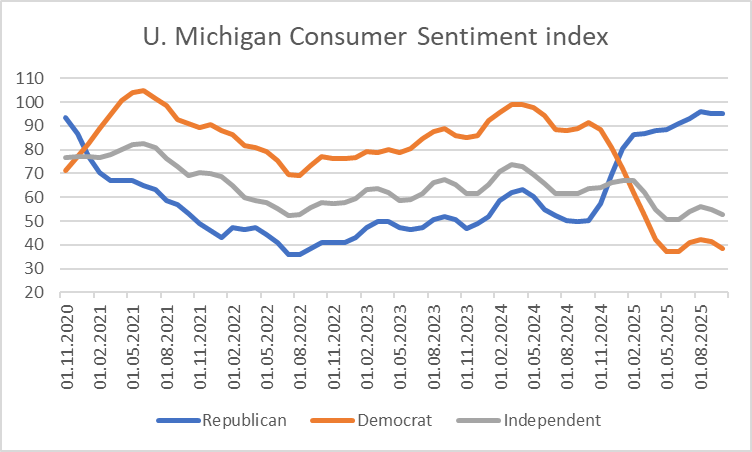
Furthermore, there is a clear political pattern. In recent months, sentiment data from the US has shown a marked divergence between Democrats and Republicans. After the November 2024 election, the mood shifted dramatically, and for many market participants, political views color risk assessments just as much as economic data. Since political controversies are greater now than at any time since World War II, the impact on the data is also greater than ever.
The bubble narrative—and what the numbers actually show
However, the strongest driver behind the pessimism is the narrative of an "AI bubble." Large segments of both professional and private investors have heard warnings regarding the rise of tech giants, and NVIDIA in particular has become the symbol of overheating. The problem is that the numbers do not support the bubble narrative. NVIDIA’s earnings per share have tripled in two years and increased forty-fold since the third quarter of 2022. The company reports that they are sold out and cannot meet demand. In other words, there are actual, powerful revenue streams behind the price increase.
Critics point out that much of the revenue comes from customers who are not yet profitable themselves. That is true, but it is not decisive. "Hyperscalers" and tech giants have enormous access to capital, and AI disruption is still in an early phase. Profitability will come later, as we have seen with most major technological breakthroughs over the last 20 years. Moreover, both nation-states and companies view AI as a strategic and existential matter. Investments will continue regardless of short-term profitability. Everything suggests that the problems lie in capacity, not demand.
Market corrections usually come in two forms: those involving liquidity and sentiment, and those caused by fundamental problems. Liquidity-driven corrections tend to be V-shaped—rapid falls and rapid recoveries—while fundamental problems lead to U- or L-shaped trajectories. AI has been the major engine behind the rise in risk assets, and all available data suggests that this engine is still running at full capacity. NVIDIA’s figures show no signs of stagnation, suppliers of related capital goods report full order books and long waiting lists, memory prices are rising, and the need for computing power is increasing faster than the industry can scale.
All of this points to the fact that the decline since October is primarily driven by liquidity and sentiment—not by changes in underlying fundamental conditions. Historically, this means the correction is likely to be short-lived, similar to those we saw in August–September 2024 and March–May 2025.
In other words: the mood is in the basement, but the foundation is strong. And often, it is precisely in such periods that the next leg of a bull market begins. The discomfort of the last month could easily be forgotten by the time spring arrives.
The bubble everyone is talking about – and we cannot find in the data
It has become almost mandatory to call artificial intelligence (AI) a bubble. Comparisons to the dot-com crash and the fiber-optic build-out around the year 2000 are constant, and the investment figures are staggering: the largest cloud companies are expected to invest over $900 billion this year and nearly $1.5 trillion next year. When Avanto reviews valuations, capacity, financing, and interest rates, we do not find a bubble. On the contrary, the key companies are priced as if the AI offering is about to disappear, demand exceeds capacity, and the core is solidly financed. Risk exists, but it is narrower and far easier to identify than the bubble narrative suggests.
Who is shouting "bubble"? And why memory, of all things?
Micron has skyrocketed. So have SK Hynix and Samsung's memory division. And as if on cue, a host of people have appeared on X, in comment sections, and during coffee breaks who have found their new favorite word: bubble. Let's pause there for a moment.
Infinite supply
What happens when machines take over human labor? In 2022, what has subsequently been called “The Chat-GPT moment” occurred. In 2026, we will have what will eventually be called “The OpenClaw moment”.